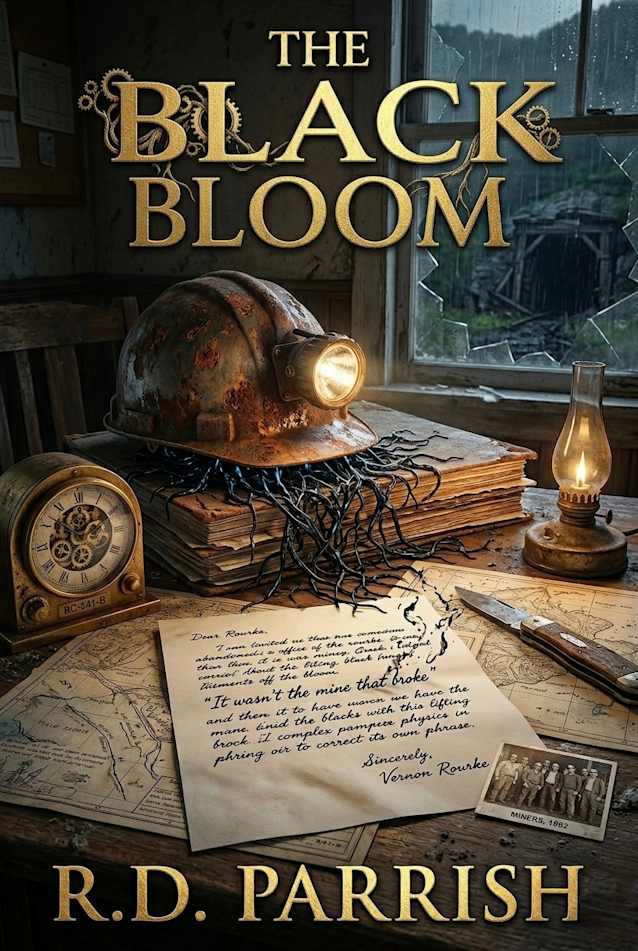
The Black Bloom: The Past Always Corrects Itself
About
THE BLACK BLOOM
The past always corrects itself.
When Mara Rourke returns to Briar Hollow to assess abandoned buildings, she expects silence. The Appalachian mining town is half-gone—boarded houses, sealed shafts, and a collapse that killed her father twenty years ago.
But the ground is warmer than it should be.
Town clerk Mae Kessler opens files that rewrite themselves overnight. Diagrams change. Ink lifts off paper and swirls into new shapes. A collapse report appears dated two months before the collapse happened.
Acoustics engineer Caleb Harland hears pulses beneath the earth—rhythmic, like breathing. When he touches the stone, it warms under his palm. Like flesh remembering contact.
And Mara sees her father descending a staircase in an empty house, flickering like corrupted footage trying to stabilize itself.
The town didn’t just bury its dead. It buried the truth. And something beneath Briar Hollow has been listening ever since—something ancient, fungal, and vast. A living archive that stores memory in mycelium and releases it in black blooms that smell like turned earth and old grief.
The Black Bloom doesn’t haunt. It corrects.
Sheriff Ruthie Cade has spent decades holding the lie together. But the organism beneath the town doesn’t care about her version of events. It only cares about what actually happened—and it’s rewriting history one memory at a time.
Documents reform. Audio recordings play voices of the dead. The past appears in hallways and alleys, flickering into focus as the fungus fills in missing details.
Mara’s father didn’t die the way she remembers. Caleb’s brother didn’t disappear without warning. The collapse wasn’t an accident.
And the closer Mara gets to the truth, the more the Bloom shows her—through vision, through paper, through stone that pulses with geological memory older than coal.
Some truths don’t fade. They grow roots. And when the ground finally finishes its correction, Briar Hollow will have to face what it tried to forget.
For readers who crave slow-burn Appalachian horror, memory as an unreliable narrator made flesh, and fungi that think in centuries instead of seconds.
If you loved Annihilation’s ecological strangeness and The Luminous Dead’s buried secrets, The Black Bloom will burrow into your mind and rewrite what you thought you knew.